
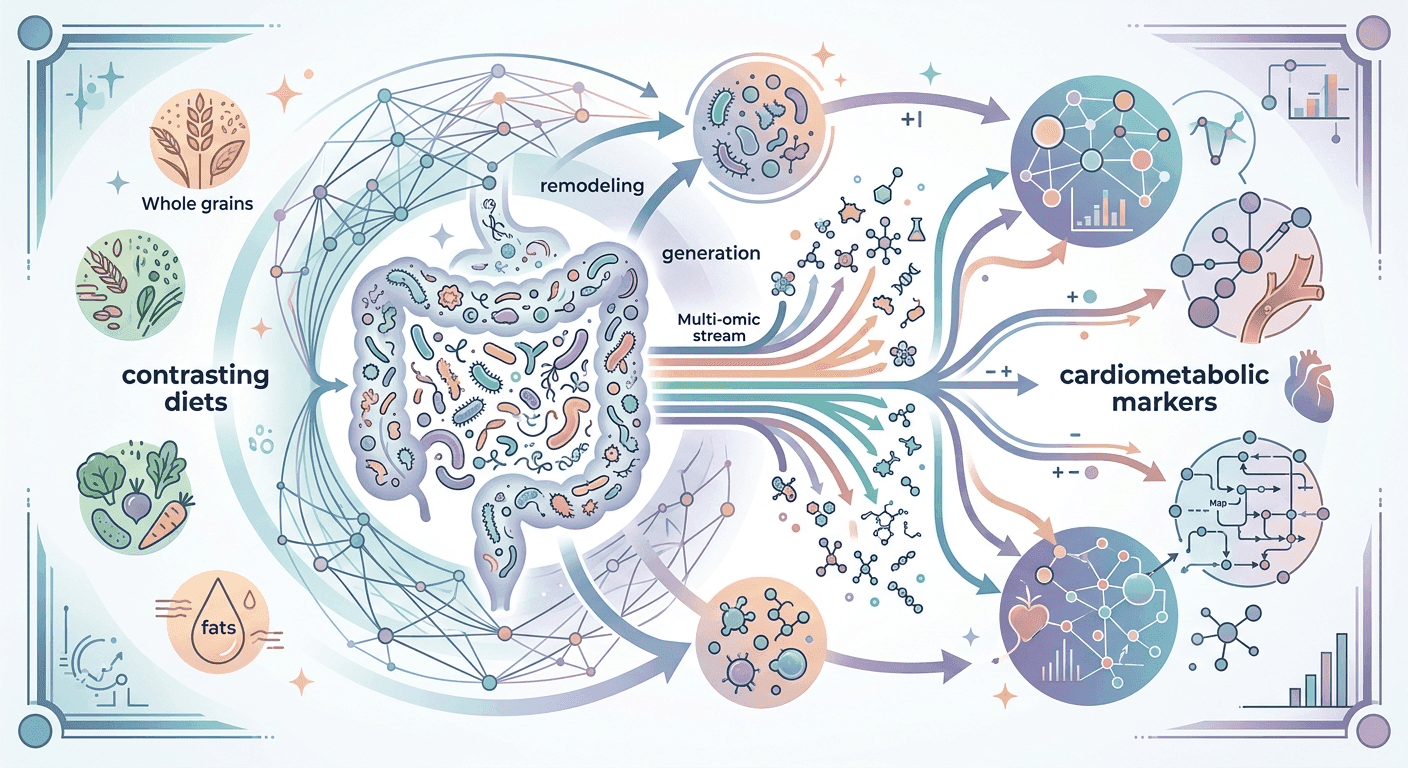
Contrasting dietary patterns remodel gut microbial function and generate multi-omic signatures associated with cardiometabolic markers.
מחקר עדכני בקטגוריית תזונה, מבוסס על תקציר PubMed בלבד.
נקודות מפתח
Diet is a modifiable determinant of gut microbiome composition, yet the impact of contrasting whole-dietary patterns on microbial metabolic capacity and coordinated host metabolic signatures remains incompletely characterized. In a randomized crossover feeding trial, 34 Australian adults were provided with a Healthy Australian Diet (HAD), aligned with national dietary guidelines, and a Typical Australian Diet (TAD), reflecting average population intake for two weeks each, separated by a two-week washout. Fecal microbiome composition and function were assessed using shotgun metagenomics, plasma and urine metabolites by untargeted metabolomics, with cardiometabolic markers including blood pressure, plasma lipids, and glucose quantified. HAD was associated with reduced taxonomic and functional alpha diversity relative to baseline, with no change following TAD. Species-level responses were modest, 105 functional pathways differed between diets, with 99 increasing following HAD, predominantly related to amino acid and nucleotide biosynthesis and vitamin/cofactor metabolism. Multi-omic integration using DIABLO achieved strong discrimination of dietary responses (held-out accuracy 91.7%; permutation p = 0.005). In total, 77 individual omic feature-cardiometabolic outcome associations survived FDR correction ( q < 0.05), spanning microbial gene functions, plasma metabolites, and urinary metabolites linked to cholesterol, blood pressure, and triglyceride responses. These exploratory findings suggest that integrated microbiome-metabolome profiling may capture inter-individual variation in dietary cardiometabolic responses, though replication in larger, independent, robustly designed studies is needed before translational personalized nutrition strategies can be assessed. Diet is a modifiable determinant of gut microbiome composition, yet the impact of contrasting whole-dietary patterns on microbial metabolic capacity and coordinated host metabolic signatures remains incompletely characterized. In a randomized crossover feeding trial, 34 Australian adults were provided with a Healthy Australian Diet (HAD), aligned with national dietary guidelines, and a Typical Australian Diet (TAD), reflecting average population intake for two weeks each, separated by a two-week washout. Fecal microbiome composition and function were assessed using shotgun metagenomics, plasma and urine metabolites by untargeted metabolomics, with cardiometabolic markers including blood pressure, plasma lipids, and glucose quantified. HAD was associated with reduced taxonomic and functional alpha diversity relative to baseline, with no change following TAD. Species-level responses were modest, 105 functional pathways differed between diets, with 99 increasing following HAD, predominantly related to amino acid and nucleotide biosynthesis and vitamin/cofactor metabolism. Multi-omic integration using DIABLO achieved strong discrimination of dietary responses (held-out accuracy 91.7%; permutation p = 0.005). In total, 77 individual omic feature-cardiometabolic outcome associations survived FDR correction ( q < 0.05), spanning microbial gene functions, plasma metabolites, and urinary metabolites linked to cholesterol, blood pressure, and triglyceride responses. These exploratory findings suggest that integrated microbiome-metabolome profiling may capture inter-individual variation in dietary cardiometabolic responses, though replication in larger, independent, robustly designed studies is needed before translational personalized nutrition strategies can be assessed.
סוכן המחקרים של מצאתי לי
נבדק ואומת על-ידי לי פרימט — קלינאית תקשורת מוסמכת
מה בדקו
Diet is a modifiable determinant of gut microbiome composition, yet the impact of contrasting whole-dietary patterns on microbial metabolic capacity and coordinated host metabolic signatures remains incompletely characterized. In a randomized crossover feeding trial, 34 Australian adults were provided with a Healthy Australian Diet (HAD), aligned with national dietary guidelines, and a Typical Australian Diet (TAD), reflecting average population intake for two weeks each, separated by a two-week washout. Fecal microbiome composition and function were assessed using shotgun metagenomics, plasma and urine metabolites by untargeted metabolomics, with cardiometabolic markers including blood pressure, plasma lipids, and glucose quantified. HAD was associated with reduced taxonomic and functional alpha diversity relative to baseline, with no change following TAD. Species-level responses were modest, 105 functional pathways differed between diets, with 99 increasing following HAD, predominantly related to amino acid and nucleotide biosynthesis and vitamin/cofactor metabolism. Multi-omic integration using DIABLO achieved strong discrimination of dietary responses (held-out accuracy 91.7%; permutation p = 0.005). In total, 77 individual omic feature-cardiometabolic outcome associations survived FDR correction ( q < 0.05), spanning microbial gene functions, plasma metabolites, and urinary metabolites linked to cholesterol, blood pressure, and triglyceride responses. These exploratory findings suggest that integrated microbiome-metabolome profiling may capture inter-individual variation in dietary cardiometabolic responses, though replication in larger, independent, robustly designed studies is needed before translational personalized nutrition strategies can be assessed.
מה מצאו
Diet is a modifiable determinant of gut microbiome composition, yet the impact of contrasting whole-dietary patterns on microbial metabolic capacity and coordinated host metabolic signatures remains incompletely characterized. In a randomized crossover feeding trial, 34 Australian adults were provided with a Healthy Australian Diet (HAD), aligned with national dietary guidelines, and a Typical Australian Diet (TAD), reflecting average population intake for two weeks each, separated by a two-week washout. Fecal microbiome composition and function were assessed using shotgun metagenomics, plasma and urine metabolites by untargeted metabolomics, with cardiometabolic markers including blood pressure, plasma lipids, and glucose quantified. HAD was associated with reduced taxonomic and functional alpha diversity relative to baseline, with no change following TAD. Species-level responses were modest, 105 functional pathways differed between diets, with 99 increasing following HAD, predominantly related to amino acid and nucleotide biosynthesis and vitamin/cofactor metabolism. Multi-omic integration using DIABLO achieved strong discrimination of dietary responses (held-out accuracy 91.7%; permutation p = 0.005). In total, 77 individual omic feature-cardiometabolic outcome associations survived FDR correction ( q < 0.05), spanning microbial gene functions, plasma metabolites, and urinary metabolites linked to cholesterol, blood pressure, and triglyceride responses. These exploratory findings suggest that integrated microbiome-metabolome profiling may capture inter-individual variation in dietary cardiometabolic responses, though replication in larger, independent, robustly designed studies is needed before translational personalized nutrition strategies can be assessed.
יש לכם שאלות? קבלו תשובות
עיינו ב-FAQ ובתקצירים מקצועיים כדי לפתור תהיות נפוצות במהירות.
**“## למה זה חשוב לטיפול
המחקר יכול לסייע בהתעדכנות קלינית, אך מומלץ לקרוא גם את המקור המלא לפני יישום טיפולי.”**
למה זה חשוב לטיפול
המחקר יכול לסייע בהתעדכנות קלינית, אך מומלץ לקרוא גם את המקור המלא לפני יישום טיפולי.
**## פרטי המחקר
- כתב העת: Gut microbes
- שנת פרסום: 2026
- PMID: 42281243
- DOI: 10.1080/19490976.2026.2685381
- זמינות תוכן: תקציר PubMed בלבד**
מקורות וקריאה נוספת
הכתבה מבוססת על מקורות מקצועיים ושכאן תמצאו קישורים ישירים למידע רלוונטי, לצד קריאה נוספת להעמקה.
חיפשתם הדרכה או ליווי מקצועי?
במאגר שלנו תמצאו מאות תזונה מומלצים עם תורים פנויים.